This is a controversial alternative hypothesis proposed by scholars like Dennis Stanford and his colleague Gary Tryon (later supported by others like James Chatters’ work, though that work is now largely discredited in its details). It suggests that the first Americans were influenced by, or even directly descended from, people of the European Paleolithic, specifically the Solutrean culture of southwestern France and Spain.
Key Premises
- Source: Europe (specifically Iberia, southern Spain, during the Solutrean period, ~20,000 to 15,00 (BP)).
- Timing: Arrival significantly earlier, potentially around 18,000 to 14,000 years ago, possibly even earlier than Clovis, during the peak cold phase of the last Ice Age.
- Technology: Proponents point to similarities between Solutrean bifacial flake technology (especially flake knives and lunates) and Clovis fluted point technology, suggesting a shared origin or cultural transmission.
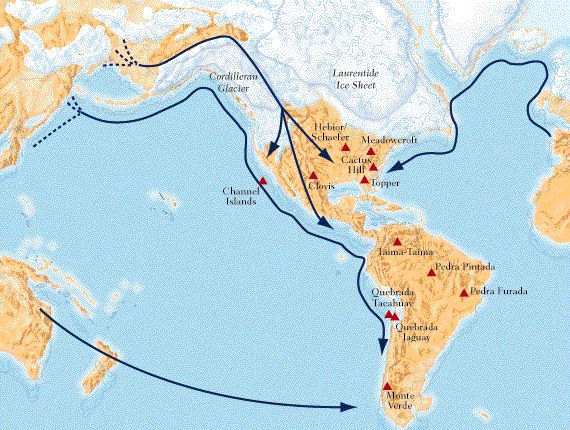
- Route: Proposed routes often involve coastal travel along the Atlantic, possibly using watercraft. A harsher climate might have made the exposed Bering Land Bridge less viable for Asian migration at that time (though some argue for a land bridge extending further south).
- Replacement/Influence: Solutreans are hypothesized to have been among the first arrivals, potentially mixing with or influencing the Asian migrants who later formed the Clovis culture.
Weather Patterns
- Atlantic Crossing: Crossing during the Last Glacial Maximum (LGM), approximately 20,000 years ago. This period was significantly colder and drier globally than today. Sea levels were much lower (~400 feet lower), potentially exposing parts of the continental shelf, but more importantly, the climate was harsher. The North Atlantic was potentially more navigable than the Arctic due to lower sea ice concentration, but conditions were still challenging. Proponents suggest they followed the edge of the ice, possibly as far south as Newfoundland.
- North America: Arriving during a period of extreme cold (peak LGM) or shortly after, facing harsh conditions with extensive ice sheets and tundra-like landscapes.
Clothing
- Similar to Clovis, clothing would have been essential for survival. However, Solutreans in Europe specialized in gear suited to the cold European climate. This included specialized equipment for hunting reindeer (like specialized knives and hide scrapers) and advanced watercraft for coastal travel. Clothing would have involved sophisticated use of hides and furs, possibly including waterproof gear for the proposed Atlantic crossings. Techniques like hide boiling for
tanning would be crucial.
Technology
- Core Technology: Solutrean technology is characterized by highly specialized, small, flake-based bifacial tools, particularly lunates (half-moon crescents) and flake knives (used for hide processing). Clovis points are distinct from these; they are larger, stemmed, and have the characteristic fluting. Proponents argue that the fluting technique might be a transmission from Solutrean technology or evidence of advanced knapping skills converging independently. The Clovis point shape itself is thought by some to be an adaptation for hafting into a hide wrap spear thrower (atlatl) system, distinct from the European spear-thrower (sling or bow) systems used with flake knives.
- Proposed Link: The link is primarily stylistic and technological. Solutrean lunates and flake knives are claimed to be technologically simpler precursors or influences on the development of Clovis points, or the fluting technique. However, this interpretation is heavily debated.
Evidence
- Archaeology: The main evidence cited is the stylistic similarity between Solutrean tools (especially lunates and flake knives) and Clovis points. However, these technologies are geographically and chronologically separated by thousands of years and vast distances. Critics argue the similarities are superficial or due to independent invention (“convergence”).
- Geography: The proposed Atlantic coastal route lacks strong archaeological evidence compared to the well-documented Beringian route.
- Technology: The functional differences between Solutrean flake-based toolkits and Clovis fluted point technology are significant. While fluting requires skill, it’s not unique to Clovis; related point styles (like Folsom) lack it. The atlatl hypothesis for Clovis points is speculative and contested.
- Genetics: Ancient DNA studies have largely refuted the Solutrean Hypothesis. Studies of ancient remains from sites like Anzick (dated to ~12,600 BP, associated with Clovis) and others show genetic continuity with modern Native Americans and lack significant European mitochondrial DNA haplogroups (like H, V, U). The genetic divergence time aligns with the Clovis-First model and Asian origins, not European. The discovery of a 12,500-year-old infant burial (Anzick-1) with Clovis-like artifacts but no detectable European mitochondrial DNA was a major blow to the hypothesis.
Summary Table
| Feature | Clovis-First Model | Solutrean Hypothesis |
|---|---|---|
| Source Region | Asia (Siberia) | Europe (Iberia) |
| Timing | ~15,000 – 13,000 years ago | ~18,000 – 14,000 years ago (or earlier) |
| Key Technology | Clovis Projectile Points (Fluted) | Solutrean Flake Knives & Lunates |
| Proposed Route | Bering Land Bridge, Ice-free Corridor(s) | Atlantic Coastal Route |
| Clothing | Fur/Hide Garments, Boots | Fur/Hide Garments, Waterproof Gear |
| Primary Evidence | Widespread Clovis Points, Asian Genetics | Stylistic Tech Similarities, Coastal Sites |
| Main Criticism | Lack of earlier widespread tech | Lack of genetic evidence, Geographical Separation, Tech Differences |
Conclusion
The Clovis-First Model remains the most widely accepted explanation for the initial peopling of the Americas, supported by extensive archaeological evidence (widespread Clovis sites), genetic data showing Asian origins, and climate evidence supporting the proposed routes and timing.
The Solutrean Hypothesis proposes an earlier European influence, pointing to potential technological similarities and a different route. While intriguing and prompting further research into coastal routes and advanced pre-Clovis technologies, it faces significant challenges, primarily the lack of supporting genetic evidence from ancient remains and the geographical and technological disconnect between the proposed source and the arrival culture. The debate remains unresolved, and more research, particularly on ancient DNA from earlier sites, is needed to fully understand the initial migrations.