Trans-Pacific Migration Hypothesis, specifically focusing on the controversial idea of Late Pleistocene migration via Antarctica or the Southern Pacific.
Important Caveat: The hypothesis that significant migration occurred via Antarctica itself as an open-water crossing (e.g., directly from South Australia/Tasmania to South America across the Drake Passage on ice floes or open water) remains highly speculative and faces significant challenges. While the Trans-Pacific Hypothesis (THP) is generally accepted, the specific Antarctic route is a fringe possibility. This analysis will explore the broader context, the feasibility of the Antarctic route, and the supporting evidence for Trans-Pacific migration.
Analyzing the Trans-Pacific Migration Hypothesis (Late Pleistocene) and the Speculative Antarctic Route
- Trans-Pacific Hypothesis (THP): The prevailing scientific view posits that the first peopling of the Americas involved a coastal migration from East Asia across the Pacific during the Late Pleistocene (around 15,00 years ago or earlier). This journey likely involved island-hopping along the ‘southern corridor’ (e.g., through the Bismarck Archipelago, Torres Strait, New Guinea, Solomon Islands) or potentially a more direct coastal voyage.
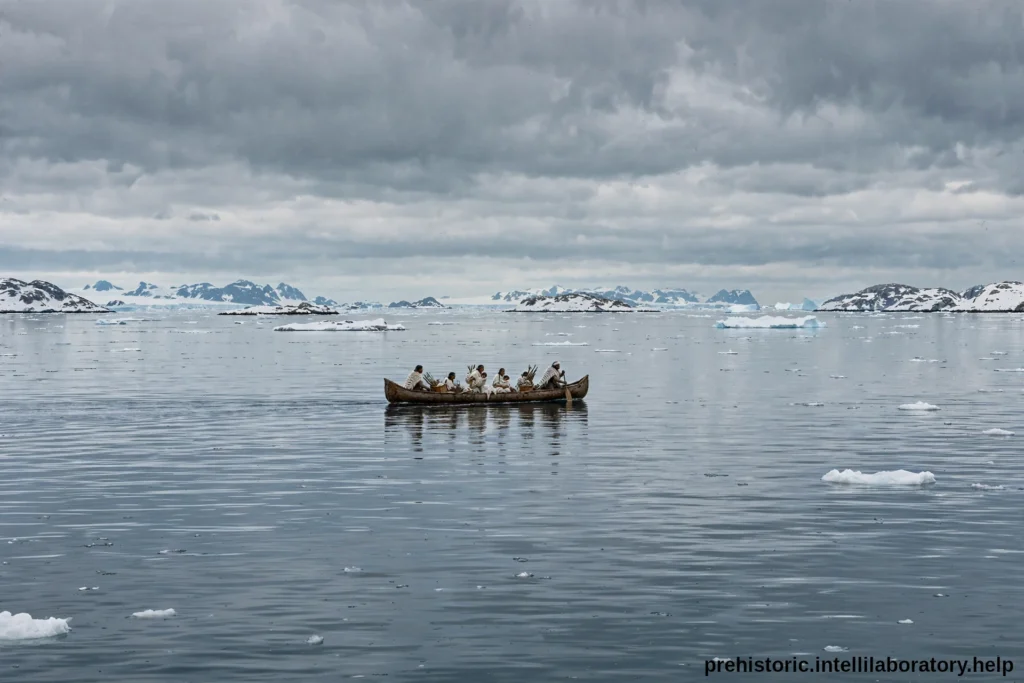
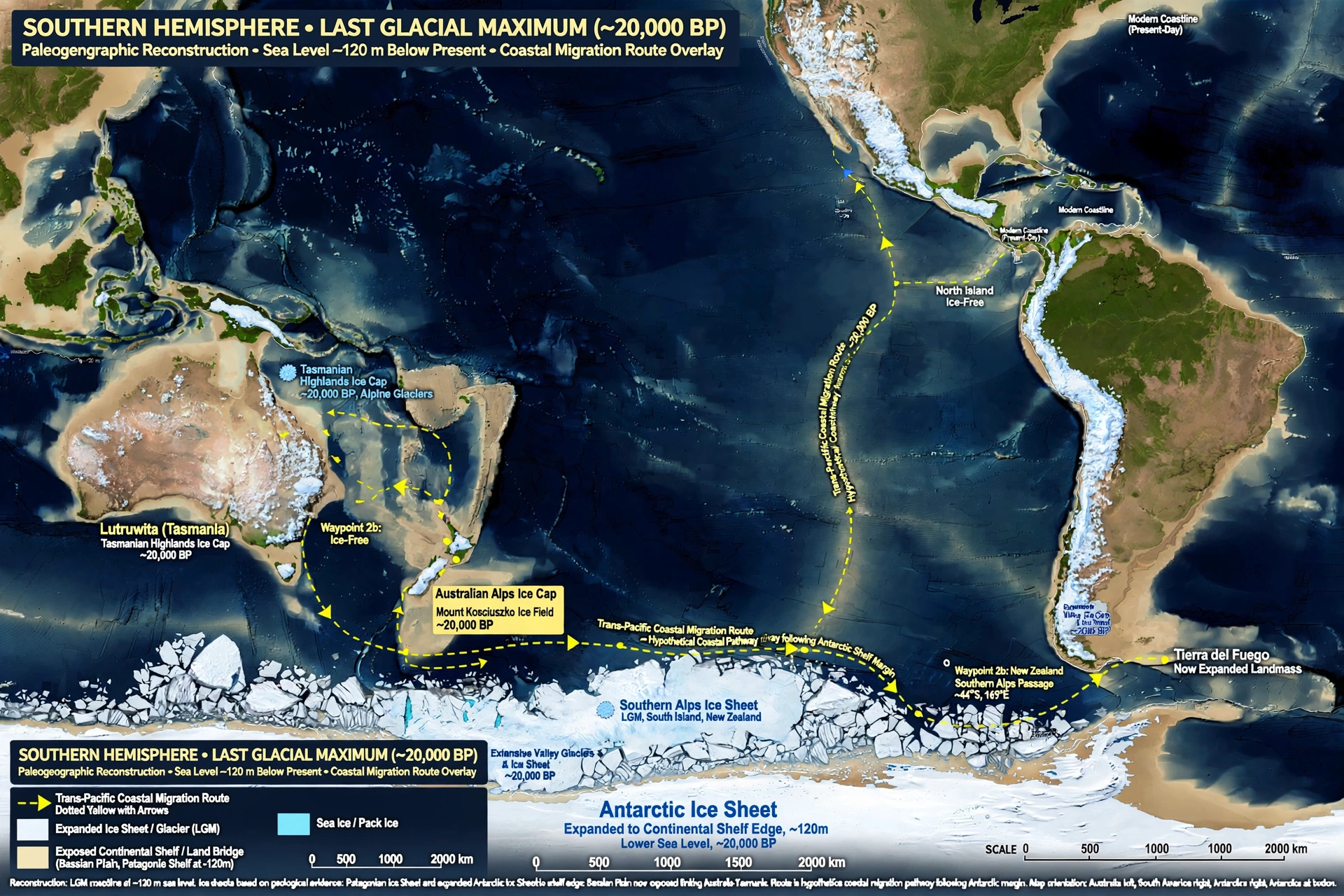
- Antarctic Route Speculation: A highly speculative alternative hypothesis suggests that some groups might have crossed the vast expanse of the Southern Pacific via Antarctica. This could involve crossing the Drake Passage on ice floes or potentially using exposed Antarctic islands (like the Antarctic Peninsula archipelago or the Scotia Arc) as stepping stones. The Last Glacial Maximum (LGM) ~20,000 years ago featured significantly lower sea levels and extensive sea ice, potentially opening temporary, albeit dangerous, routes.
- Evidence: Genetic studies show pre-Columbian contact possibilities (e.g., mtDNA haplogroup C4c) but do not definitively support the Antarctic route. Fossil evidence is lacking. The extreme environmental conditions (cold, vast distances, lack of resources) make this route exceptionally challenging, though not entirely impossible under specific LGM conditions.
The peopling of the Americas is one of the most studied and debated topics in archaeology and anthropology. The dominant model involves the Beringian Land Bridge (Beringia) connecting Asia and North America during the LGM. However, the Trans-Pacific Migration Hypothesis proposes that a distinct group, potentially originating from Australia or the Pacific Islands, crossed the Pacific Ocean to reach South America, possibly via coastal voyages or island-hopping.
This document analyzes the broader Trans-Pacific Hypothesis and delves into the specific, albeit controversial, possibility of a migration route involving the Southern Pacific and Antarctica during the Late Pleistocene (~20,000 years ago). We will examine the environmental conditions, fossil evidence, genetic data, and the overall feasibility of such a migration.
The Trans-Pacific Migration Hypothesis (THP)** - Core Idea: The THP suggests that the initial migration into the Americas did not solely occur via Beringia. A separate, coastal-based migration from East Asia or Melanesia could have bypassed Beringia entirely, crossing the Pacific to reach the Americas’ southern tip (Tierra del Fuego) or coastal regions of North America.
- Timing: Evidence points towards migrations starting around 15,000-16,000 years ago, but genetic and archaeological finds in South America date some arrivals as early as 18,000-20,000 years ago, pushing the THP timeframe earlier.
- Routes: The most likely routes involve coastal navigation. Key possibilities include:
- Northern Pacific Coastal Route: Crossing the Pacific from the North American west coast to Asia (less likely for initial arrival in the Americas).
- Southern Pacific Coastal Route (or ‘Southern Corridor’): This is the most favored THP route. It involves voyages along the Pacific coast from East Asia, potentially reaching islands like Hainan, Java, Sumatra, then navigating through the Sunda Shelf (now submerged), potentially the Bismarck Archipelago, Torres Strait, New Guinea, Solomon Islands, Vanuatu, New Caledonia, potentially reaching South America via the Falkland Islands or southern Patagonia. This route leverages the lower sea levels of the LGM. The Speculative Antarctic Route: Crossing the Drake Passage (20,000 years ago)** This section addresses the specific question of crossing the Drake Passage (between South America and Antarctica) during the LGM (~20,000 years ago), specifically the idea of crossing via Antarctica or using its islands.
- Environmental Conditions (LGM):
- Sea Level: Global sea level was approximately 120 meters lower than today, exposing continental shelves around the world, including parts of eastern Australia and the Pacific coast of South America.
- Antarctic Ice Sheet: The Antarctic Ice Sheet was likely smaller than its Holocene extent but still vast. Sea ice in the Southern Ocean was probably more extensive than average, though regional variability existed. The extent and seasonality of this sea ice would be crucial.
- Temperatures: The climate was colder globally, including the Southern Hemisphere. Conditions near Antarctica would have been extremely harsh, with freezing sea surface temperatures, low air temperatures, and potentially katabatic winds.
- Drake Passage: The width of the Drake Passage at LGM is uncertain but likely similar or slightly wider than today. Crucially, was it navigable? This depends entirely on sea ice conditions. A continuous, thick sea ice cover would block passage. Periods of open water or narrow channels might have existed, but survival on open water in such a climate would be precarious.
- Feasibility of the Antarctic Route:
- Direct Drake Crossing on Open Water/Ice Floes: Crossing the Drake Passage (~500 km wide at its narrowest) directly on open water or unstable sea ice during the LGM is considered highly improbable due to the extreme cold and likely extensive sea ice cover. Navigating such a crossing would be incredibly dangerous with prehistoric technology. Crossing via the Antarctic continent itself is geographically impossible as an open crossing route.
- Using Exposed Antarctic Islands: A more plausible, though still highly speculative, scenario involves using the islands of the Antarctic Peninsula (South Shetland Islands, Antarctic Circle Islands) and the Scotia Arc (South Georgia, Falkland Islands/Malvinas) as stepping stones or refueling points.
- Pros: These islands offer potential resources (kelp forests, seals, birds) and potentially sheltered bays compared to the open Drake Passage. Some islands might have had exposed land bridges or navigable waterways during the LGM.
- Cons: Navigating these treacherous, iceberg-filled, and cold waters remains daunting. The ecological conditions might not have supported large populations. The sheer distance and isolation are immense. The idea requires these islands to have been accessible and potentially habitable during the LGM, which is plausible given lower sea levels but still speculative.
- Antarctic Passage as Part of a Broader Strategy: Antarctica could theoretically be part of a longer, circum-Antarctic migration route, perhaps from Australia or South America to other islands in the Scotia Arc or southern Pacific, not necessarily directly from Tasmanian/Southern Australian to southern South American mainland via Antarctica as the primary crossing point. Fossil Evidence** Direct fossil evidence supporting a specific Trans-Pacific or Antarctic migration route is scarce and often debated.
- Early American Migrants: Archaeological sites in South America like Monte Verde (dated to ~18,500-14,500 cal BP) provide evidence of early human presence, potentially predating the Beringia land bridge. However, their association with specific Pacific Islander or Antarctic DNA is not established.
- Pacific Islands: Some Pacific islands show evidence of early, isolated settlement, but these are generally linked to Asian migration via Melanesia and Polynesia, not necessarily a direct link to Antarctica or South America.
- Lack of Direct Evidence: There is no credible fossil evidence (e.g., bones, tools) suggesting humans reached or inhabited Antarctica during the LGM in numbers sufficient to support a migration route. The extreme conditions make survival extremely unlikely, even for short periods. Antarctic exploration remains largely restricted to the summer season and specific coastal areas due to the dangers and cold. Genetic Evidence (DNA)** Genetic studies are crucial for testing migration hypotheses, though definitive proof for the Antarctic route is lacking.
- mtDNA Haplogroup C4c: This mitochondrial DNA haplogroup is found at higher frequencies in some indigenous groups of South America (e.g., Kawás, Tsimané, Yagua, Yawalí) and in Australia and Melanesia. Its presence in both the ‘source’ (Pacific) and ‘sink’ (South America) populations suggests a pre-Columbian maternal exchange or contact. This could potentially support the THP or even an Antarctic-Pacific link, as haplogroup C4c is common in Melanesians (who might have used the southern Pacific) and also in some South American groups.
- Haplogroup Q: Also found in both South America and East Asia, contributing to the peopling of the Americas.
- Interpretation: While the presence of C4c strengthens the possibility of pre-Columbian contact or a southern route, it does not prove the Antarctic route. It fits better with the Southern Pacific coastal or island-hopping routes (THP) rather than an open Drake Passage crossing or Antarctic island hopping. It indicates gene flow somewhere between East Asia/Australia and South America, but the exact path remains unclear. More comprehensive genomic studies are needed to trace specific lineages and migration timings definitively. Indigenous DNA Considerations** We must consider the broader range of indigenous populations potentially involved:
- Southern Australia & Tasmania: Groups like Aboriginal Australians and Palauans are considered potential source populations for the THP due to shared genetic markers (e.g., C4c) and similar coastal environments. Tasmanian Aborigenes, geographically close, might have been involved locally.
- South Pacific Islands: Melanesians (Papua New Guinea, surrounding islands) are crucial for the THP due to their location and DNA haplogroups (C4c, Q).
Polynesians are later arrivals. - South America (Southern Cone): Indigenous groups in southern Chile, Argentina, and the Falkland Islands show genetic markers potentially linked to Pacific or Asian sources. Their DNA needs to be analyzed within the context of the entire southern indigenous pool.
- Trans-Pacific Hypothesis (THP): Strongly supported by archaeological and genetic evidence pointing to early, coastal-based migration into the Americas from the Pacific side, likely via the ‘southern corridor’. This is the most likely route for the initial peopling of South America.
- Antarctic Route (Drake Passage Crossing): Highly speculative. Crossing the Drake Passage directly on open water or unstable ice floes during the LGM (~20,000 years ago) is unlikely due to extreme cold, likely extensive sea ice, and vast distance. Using the Antarctic islands as stepping stones is theoretically possible but lacks strong supporting evidence (fossil or genetic).
- Feasibility: The environmental conditions during the LGM made the Antarctic environment extremely hazardous. Navigating the Southern Ocean or the Drake Passage would require exceptional seafaring skills and technology, which existed in some Pacific cultures, but the specific challenges of crossing or utilizing Antarctica are immense.
- Need for Further Research: More detailed paleoenvironmental reconstructions (sea ice extent, temperature, sea level), archaeological surveys in remote southern Pacific islands and Antarctica (where safe), and comprehensive genomic studies of relevant populations are needed to test the Antarctic route hypothesis rigorously. For now, the THP via the Southern Pacific remains the best-supported explanation for early migration to the Americas.
- In summary, while the idea of a migration from southern Australia or the Pacific Islands reaching South America via the Drake Passage or Antarctica during the LGM is intriguing and not completely ruled out, it remains speculative and faces significant environmental and logistical hurdles. The more established THP via coastal voyages in the Southern Pacific is currently the favored model for the initial peopling of the Americas by trans-Pacific migrants. Genetic evidence supports pre-Columbian contact possibilities but does not specifically confirm the Antarctic route. The extreme conditions of Antarctica during the LGM make it an unlikely primary migration corridor. Further interdisciplinary research is essential.