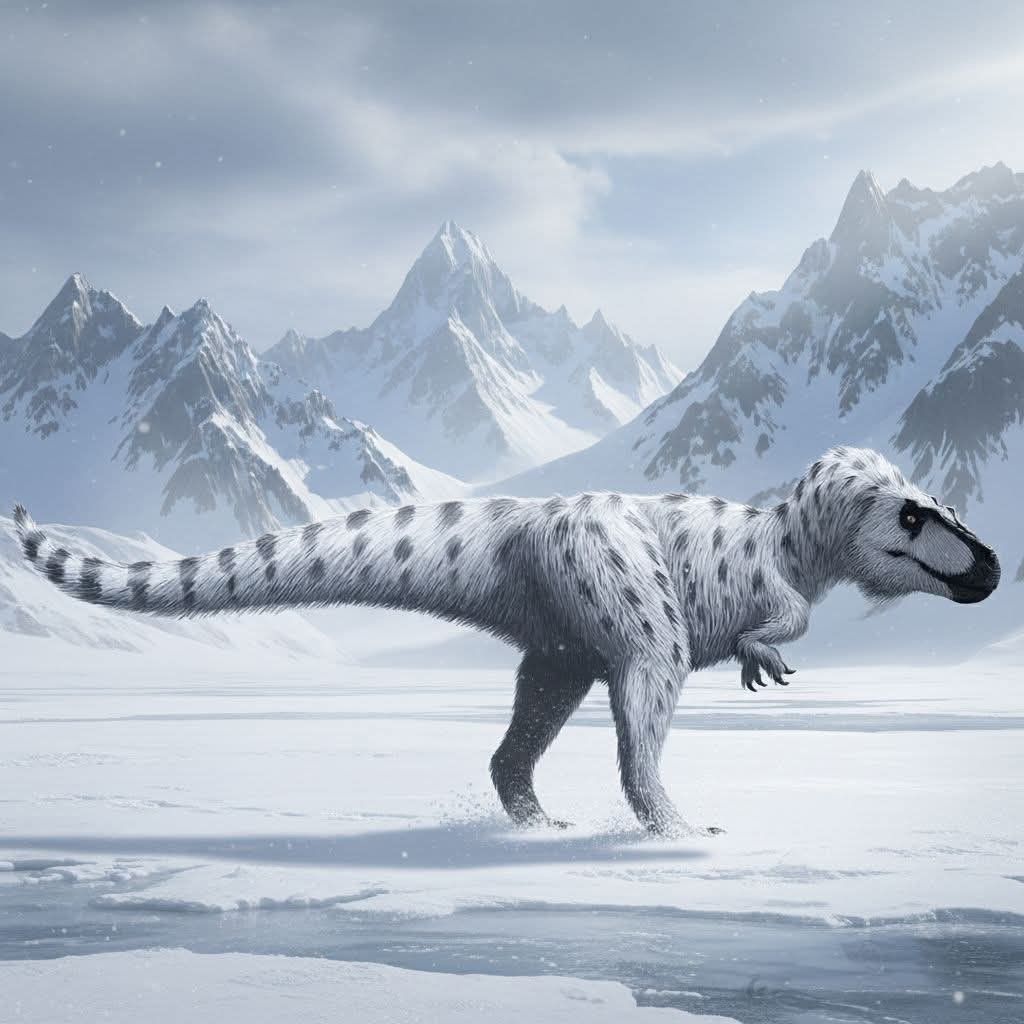
Imagine a world vastly different from today. Picture lush green forests clinging to the shores of ancient supercontinents, but further north, under a canopy of giant conifers and cycads, the climate grew significantly colder. The Arctic wasn’t a frozen wasteland then, but a dynamic ecosystem shaped by the long shadows of late summer and the slow retreat of polar night. During the Late Cretaceous, roughly 70-66 million years ago, these polar regions were home to surprising and resilient dinosaurs, creatures adapted to life under the midnight sun and through deep winters. The discovery of Nanuqsaurus offers a fascinating glimpse
into this hidden world.
Setting the Scene: The Cretaceous Polar World
Before we delve into the dinosaurs themselves, let’s understand their world. The supercontinent Laurasia, which included North America, Europe, and Asia, began to break apart. In the high north, centered around what is now Alaska and Canada’s Yukon Territory, the climate was polar. This meant:
- Seasonal Extremes: Long periods of continuous daylight (up to six months) in summer, followed by long periods of darkness (up to ten months) in winter. Temperatures could drop below freezing.
- Environment: Not icy like today, but cool and seasonal. Evidence includes coniferous forests (like Pine and Larch species), ferns, cycads, and perhaps some flowering plants (Angiosperms) were starting to diversify. Rivers flowed, and coastal plains extended southward.
- Sun Angle: During the peak summer, the sun would barely dip below the horizon at the poles (around 24 degrees below), meaning continuous twilight or light. In winter, the sun would stay close to the horizon, resulting in very short days (around 4-5 hours).
This challenging environment required unique adaptations for survival, particularly for animals living year-round.
Unearthing a Polar Bear Dinosaur: Nanuqsaurus mirificus
Discovered in 2015 from rocks dated to the late Santonian stage (around 70-66 million years ago) in Alaska, Nanuqsaurus is one of the most significant finds from this polar environment.
- The Name: Nanuq means “polar bear” in the Inupiat language of Alaska. Saurus is the dinosaur suffix. Mirificus means “wondrous” or “marvelous,” reflecting the unique nature of the discovery. Together, “wondrous polar bear dinosaur.”
- The Fossil: The holotype (specimen AL 31353) is a partial skeleton including parts of the skull, vertebrae, ribs, pelvis, forelimbs, and hindlimbs. Other bones from the same location and time period add to our understanding.
- Who Was It?
- Classification: Nanuqsaurus is a theropod dinosaur, related to Tyrannosaurs (the family Tyrannosauridae). It’s often described as resembling a “coyote-sized” or “donkey-sized” Tyrannosaurus. It wasn’t a giant; estimates place it around 6-9 meters (20-30 feet) in length.
- Distinct Features: The fossils show adaptations hinting at its polar habitat. While not definitively proven insulation like in mammals, its size might have helped. Its relatively small size compared to other Cretaceous theropods in warmer regions could be an adaptation for a cooler climate (smaller animals lose heat faster but require less energy). The skull shows features suggesting a diet potentially including tougher vegetation or smaller animals than its larger relatives.
Adaptations for a Challenging Climate
How did dinosaurs survive such harsh conditions? While direct evidence is limited, paleontologists infer several possibilities based on Nanuqsaurus and other finds:
- Behavioral Adaptations: Hibernation? Migration? We don’t know for sure, but it’s possible. Smaller dinosaurs might have been able to migrate further south for food during harsh winters.
- Physiological Adaptations:
- Insulation: Some polar dinosaurs, like Cryolophosaurus (Antarctica), had elaborate crests or sail-like structures (e.g., Spinosaurus-like neural spines). While the function isn’t always clear (display, thermoregulation), large body size (in some cases) or specific skin impressions could hint at insulation. Nanu qsaurus‘s smaller size might be a trade-off, perhaps indicating a different strategy.
- Metabolism: A higher metabolic rate could help generate and retain heat.
- Dietary Adaptations: These polar dinosaurs likely fed on plants and animals available in their specific environment. Nanuqsaurus might have browsed lower vegetation or preyed on smaller animals. Its teeth, if similar to other theropods, were likely suited for slicing flesh, but the possibility of a herbivorous diet during certain times isn’t ruled out.
- Habitat Use: Living in forested areas provided some shelter from the extreme cold and wind compared to open tundra.
Other Dwellers of the Cretaceous North
Nanuqsaurus wasn’t alone. Fossil evidence from Alaska, Canada, and even Antarctica reveals a diverse polar fauna:
- Cryolophosaurus (Antarctica): Discovered in the early 1990s, this is arguably the most famous polar dinosaur. About the size of an Edmontosaurus (10-12 meters), it was a theropod with a distinctive crest over its snout. Found in rocks from the early Cretaceous (about 95-100 million years ago), it predates the Nanuqsaurus fauna. Its discovery was revolutionary, proving dinosaurs lived in polar regions much earlier than previously thought.
- Thescelosaurus (Alaska): Thescelosaurus is a hadrosaurid (duck-billed dinosaur), though often described as closer to the ancestors of hadrosaurs. Found in Alaska alongside Nanuqsaurus, it was a smaller, bipedal, plant-eating dinosaur, perhaps around the size of a modern horse (up to 6 meters). Its presence in Alaska indicates that polar regions supported ornithischian dinosaurs as well.
- Triceratops (Alaska): Fossils of Triceratops have been found in Alaska, dating to the late Maastrichtian stage (around 66 million years ago), just before the mass extinction. Triceratops was a large, horned herbivore, suggesting that even the very end of the Cretaceous saw large, specialized dinosaurs thriving in the Arctic.
- Edmontosaurus (Alaska, Canada): The gentle giant of the herbivores, Edmontosaurus (up to 9-10 meters long) was widespread. Its fossils in Alaska and Canada indicate that these large, plant-eating dinosaurs were part of the polar ecosystem.
- Hypsilophodon (Alaska): This small, early ornithopod (plant-eating dinosaur) was likely a swift browser, found in both Alaska and other locations. Its small size might have been advantageous in cooler climates.
Analysis: Surviving the Freeze
The existence and diversity of dinosaurs in polar regions challenge our modern perception of dinosaurs as exclusively tropical or temperate beasts. These creatures managed to adapt to lower temperatures, likely through a combination of behavioral strategies (perhaps migration or hibernation), physiological changes (potential insulation, higher metabolic rates), and exploiting specific ecological niches provided by the seasonal forests.
Nanuqsaurus represents a crucial piece of this puzzle. Its discovery in Alaska demonstrates that tyrant dinosaurs, often top predators in warmer climates, also ventured into the Arctic. Its relatively small size compared to its southern relatives might be a key adaptation. The fact that multiple types of dinosaurs (theropods, ornithischians like Thescelosaurus, Triceratops, and Edmontosaurus) thrived in this region underscores the surprising resilience and diversity of life during the Cretaceous polar periods.
Conclusion: A Wondrous Legacy
The study of polar dinosaurs like Nanuqsaurus opens a window into a forgotten world. It reveals that life, even large and complex forms like dinosaurs, was capable of thriving in the challenging conditions of Earth’s polar regions millions of years ago. These ancient beasts, surviving under different skies and seasons, remind us of the incredible adaptability of life on our planet. The fossils unearthed from the Arctic and Antarctic are not just relics; they are testament to ecosystems operating under extreme conditions, expanding our understanding of the Mesozoic world far beyond the tropics.