Okay, let’s break down the complex story of Homo sapiens’ migration out of Africa and into Australia, focusing on the environmental context, the critical role of seafaring technology, and the significance of behavioral and technological innovations.
I. The Out of Africa Migration (Approx. 70-60,000 YA)
- Environmental Context:
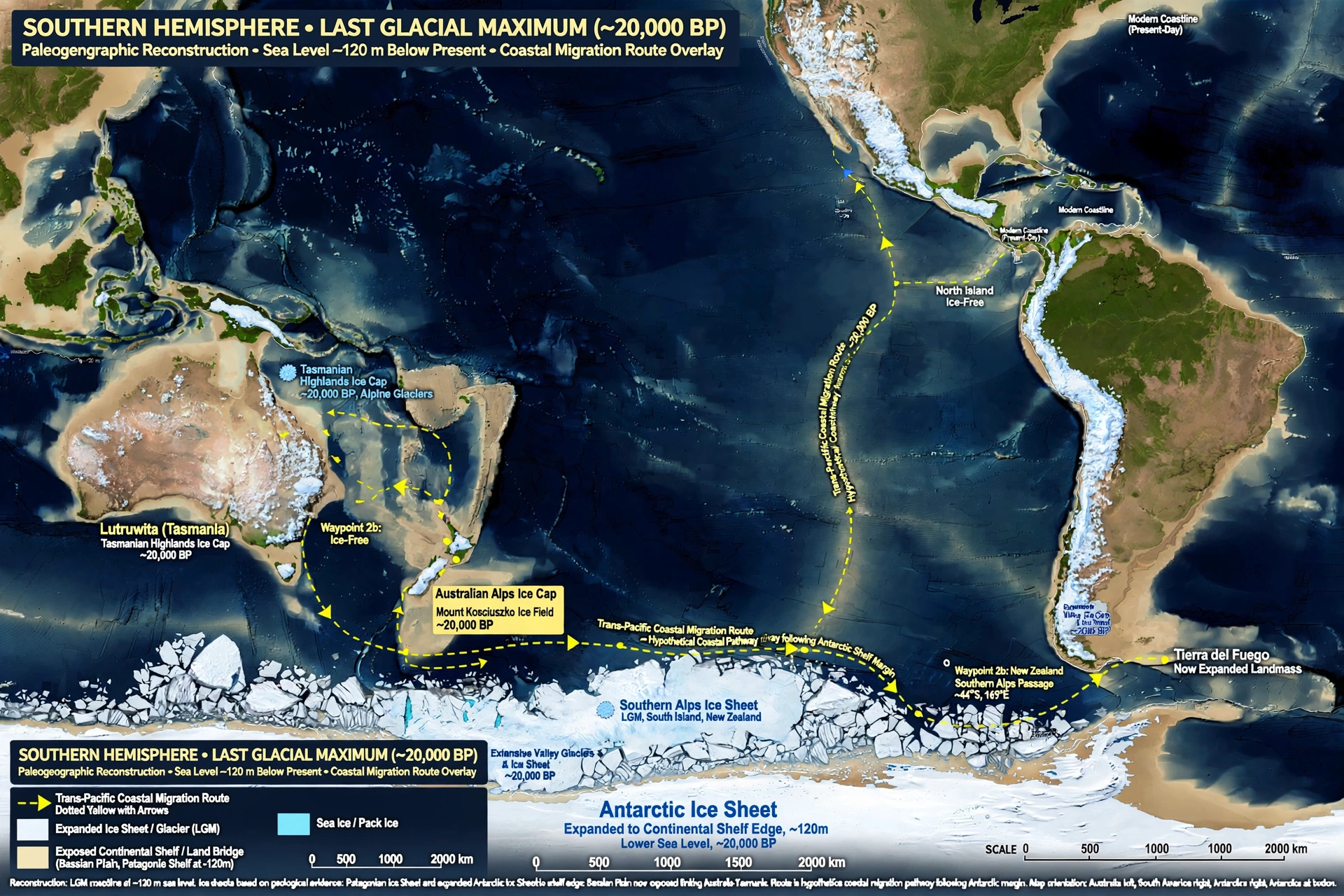
- Last Glacial Maximum (LGM) ~20,000 YA: Global temperatures were lower, ice sheets were extensive, and global sea levels were significantly lower (~120m below current). This exposed vast stretches of the continental shelf around the Mediterranean, Red Sea, and Persian Gulf, effectively creating land bridges.
- Rising Seas Post-LGM: As the climate warmed and ice melted, sea levels began to rise rapidly, starting around 18,00 YA. This rising water level was crucial.
- It submerged the land bridges connecting the Levantine coast of Africa to Arabia and the Arabian Peninsula to the Persian Gulf coastline (the “southern” route).
- It also submerged the land bridges connecting Arabia to the southern tip of the Persian Gulf and potentially other coastal routes, forcing the exit point further north.
- The Gateway: The most likely exit route involved navigating the treacherous and relatively narrow Bab el Mandab strait between the Horn of Africa (modern-day Yemen/Eritrea/Somalia) and the Arabian Peninsula. This route required crossing the Red Sea or the Gulfs of Suez and Akaba. This crossing implies sophisticated seafaring technology and likely occurred when sea levels were still relatively low enough to potentially use shallow, coastal routes or when crossing narrow straits.
- The Journey:
- Boat Building: The successful crossing of the Red Sea or the associated gulfs indicates that early Homo sapiens possessed the behavioral and technological innovation to build seaworthy watercraft capable of open-ocean travel, even if the seas were not as stormy as they are today due to lower sea levels and potentially different climate patterns.
- Coastal Route: Once out of the Levant, the migration likely followed the coastline, moving north along the Levantine coast, then west through Anatolia (modern Turkey), into Europe, and eventually south into Asia. Rising sea levels periodically flooded these coastal routes, forcing groups to move inland or adapt, but the coastline remained a primary avenue for expansion due to resource availability and shorter distances over water compared to land.
- Seafaring Technology (Out of Africa):
- Likely Primitive: Evidence for sophisticated boats is scarce. The earliest plausible boat remains (waterlogged timber) date to around 7000-8000 YA in the Near East and around 5000 YA in the Pacific. The Red Sea crossing likely occurred much earlier.
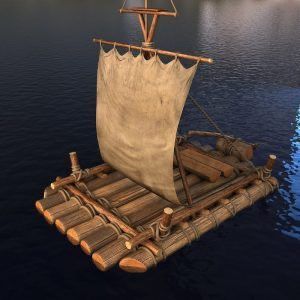
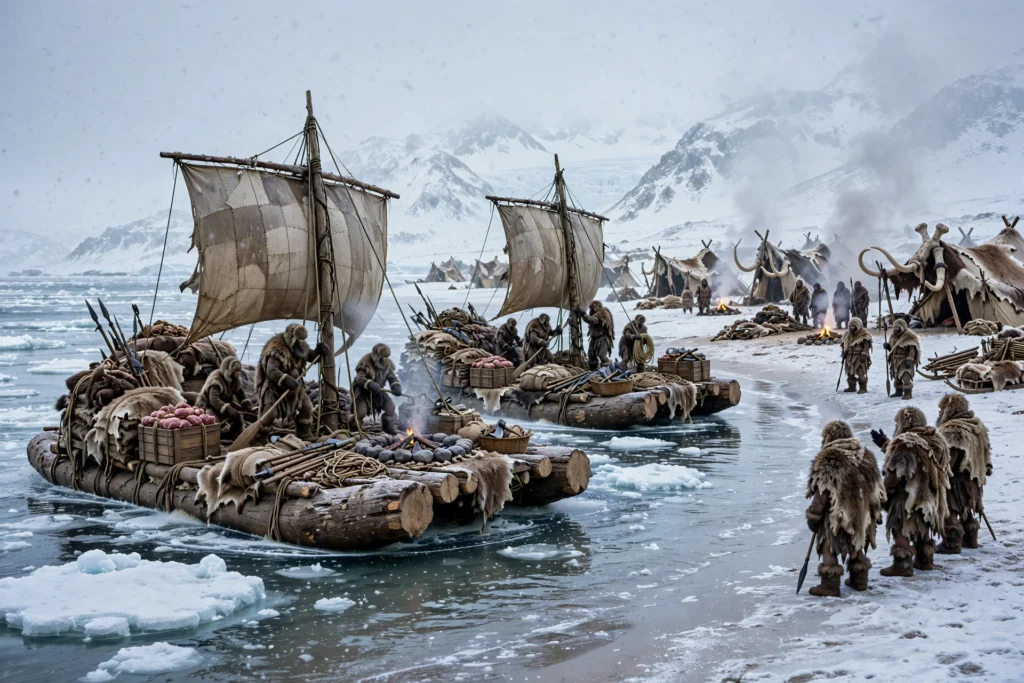
- Possible Craft: The simplest explanation for crossing narrow straits or navigating coastal waters involves primitive rafts or log-traps (筏子). These are essentially large, stable platforms built from捆绑的 logs or planks, designed to float and catch ocean currents rather than sail efficiently. Outriggers (like those on Polynesian voyaging canoes) are unlikely to have been present so early, as they require complex engineering and likely originated independently in multiple regions later (e.g., Austronesian expansion).
- Limited Open Ocean Travel: While capable of crossing narrow straits, the evidence for long-distance open-ocean voyages out of Africa proper (beyond the immediate Levant) before the much later Indian Ocean and Pacific expansions is weak. Coastal navigation along the Levantine and European/Mediterranean coasts is more plausible.
II. The Australian Migration (Approx. 50,000 – 40,000 YA? – Debate continues)
- Environmental Context:
- Timing: The colonization of Australia is generally dated between 66,000 and 40,000 YA, with the most commonly accepted window being around 50,000-40,000 YA. This timing coincides closely with the peak of the LGM, when sea levels were lowest (~70m below present).
- LGM Lowstand: During the LGM, global sea levels were at their lowest. This exposed the Sunda Shelf (connecting Southeast Asia to Sumatra, Java, etc.) and crucially, exposed the Sahul Shelf (connecting Australia, Tasmania, and New Guinea). At this time, continental Sahul existed, meaning Australia, New Guinea, and Tasmania were connected by land, forming a single super-continent (Sahul) with New Zealand still separate.
- Rising Seas: As the LGM ended and seas rose, this Sahul land bridge submerged progressively. The final submergence occurred around 14,000 YA, isolating Tasmania/New Zealand. However, the initial migration onto Sahul (which included Australia and New Guinea) likely happened earlier, during the LGM when the shelf was exposed and potentially traversable from the north via land.
- The Journey:
- Land Bridge Route: The most popular theory suggests the migration onto Sahul occurred via a land bridge from the north (New Guinea side). This route is geologically straightforward and aligns with the low sea levels of the LGM.
- Seafaring Route: However, there is significant debate and alternative theories:
- Stepping Stone: Some propose that humans used islands (like Timor, Alor, Sumba) as stepping stones after sea levels had risen enough to flood the Sahul land bridge but before they reached their final high level. This would have required sophisticated seafaring and planning, potentially using outriggered craft or sophisticated rafts. This theory gains traction due to geological evidence of human presence on Timor around 50,000 YA, predating the earliest confirmed dates for Australia.
- Coastal Route: A combination of land bridge and coastal routes (rafting along the coast) is also possible.
- Seafaring Technology (Australian Migration):
- Technological Sophistication: The colonization of Sahul, especially if it involved crossing the Timor Sea or navigating the complex Torres Strait later, implies a higher level of seafaring technology and navigational skill than the simple Red Sea crossing.
- Rafts vs. Canoes: The debate hinges on the available evidence and the proposed route/technology. If the stepping stone theory is correct, it strongly suggests the use of stable, fast-drifting rafts capable of inter-island voyages (potentially several hundred miles). These rafts (like the waka ama of Polynesia, though later, or the东南亚 rafts) are efficient for coastal travel and using currents but less maneuverable than protracted canoes.
- Outriggers: The evidence for early outrigger technology specifically enabling the Australian migration is less clear than in the Polynesian voyages much later. Outriggers provide stability and allow sailing into the wind. While plausible, the timeline and archaeological evidence are less direct than the raft/stepping stone hypothesis for some theories. However, the convergence of this technology in the Pacific suggests it was a significant innovation, and it
might have developed independently in Australia/Southeast Asia around the same time or slightly later.
III. Behavioral and Technological Innovations: The Drivers
- Behavioral Innovations:
- Planning and Long-Distance Travel: Migrating across the Red Sea or undertaking voyages across potentially vast stretches of open ocean requires long-term planning, risk assessment, and the ability to mobilize groups for arduous journeys.
- Advanced Navigation: Navigating coastal waters or open oceans requires skills in reading currents, winds, stars, ocean swells, bird behavior, and other environmental cues. This implies abstract thought, spatial reasoning, and complex knowledge transmission.
- Maritime Foraging: Coastal and island environments offer different food resources (shellfish, fish, marine mammals, seaweed) and different hazards (waves, storms, salt exposure). Successful migration implies adaptation to these new dietary and environmental challenges.
- Risk-Taking: Venturing onto the open sea is inherently risky. The motivation to do so – likely driven by population pressure, resource scarcity, or pursuit of new opportunities – represents a significant behavioral shift.
- Technological Innovations (Seafaring Focus):
- Woodworking and Shaping: Building boats requires understanding wood properties, shaping techniques, and joining methods. Evidence from sites like Pemba in Mozambique shows sophisticated woodworking capabilities in Africa concurrent with early modern human presence.
- Seafaring Vessel Construction: The core innovation: designing and building craft capable of surviving and navigating marine environments. This is the most direct link to the successful migrations.
- Propulsion and Steering: Efficient ways to move the boat (sails, paddles, oars) and steer it (rudders, steering oars) were necessary.
IV. Analysis and Summary
- Environmental Triggers: Climate change, specifically the waxing and waning of global glaciation and the associated dramatic rises and falls in sea level, was a fundamental driver of human migration. It created both barriers (submerging land bridges) and opportunities (exposing land bridges, creating navigable waterways, creating stepping stones). The timing of the Australian migration coincided with the peak of the LGM, suggesting land-based travel was possible, but the subsequent sea-level rise forced a closer look at the sea as a pathway.
- Seafaring as Key: The successful exit from Africa via the Red Sea and the colonization of Sahul (and likely the stepping-stone colonization of islands like Timor) required seafaring technology. This wasn’t simple wading or beach-hopping.
- Primitive Technology: For the early African migration, simple rafts or log-traps seem plausible for crossing narrow straits. For the Australian migration, especially the stepping-stone hypothesis, more advanced rafts capable of open-ocean travel are likely needed. Outrigger technology might have been present but perhaps not essential for the initial land bridge crossing.
- Behavioral Leap: The most significant innovation might be behavioral. The willingness and ability to travel long distances across open water, combined with the necessary navigation and survival skills, represents a cognitive and cultural leap that enabled Homo sapiens to exploit marine environments and colonize previously inaccessible lands.
- Rapid Dispersal: The relatively rapid colonization of coastal routes out of Africa and later Sahul suggests that the behavioral and technological foundations for seafaring were established relatively early in the species’ history, perhaps developing alongside other key innovations like complex language, symbolic behavior, and advanced toolkits.
- Uncertainty: Dates, routes, and the specific technology used remain subjects of active research and debate. The sophistication of early seafaring technology is still being assessed from archaeological finds.
Conclusion
The Out of Africa and Australian migrations were profoundly shaped by global environmental shifts, particularly sea-level changes tied to climate cycles. These changes forced Homo sapiens to adapt or find new routes. Seafaring technology, likely starting with simple rafts but potentially advancing to more sophisticated craft like outriggered rafts for longer voyages, was absolutely essential for crossing key geographical barriers (Red Sea, Timor Sea, Torres Strait) and colonizing islands and continents. Crucially, these migrations were facilitated by a combination of behavioral innovations (long-distance
planning, navigation, risk-taking, adaptation) and technological innovations (woodworking, boat building). These innovations allowed our species to overcome formidable environmental challenges and embark on the long journey that eventually populated the globe.